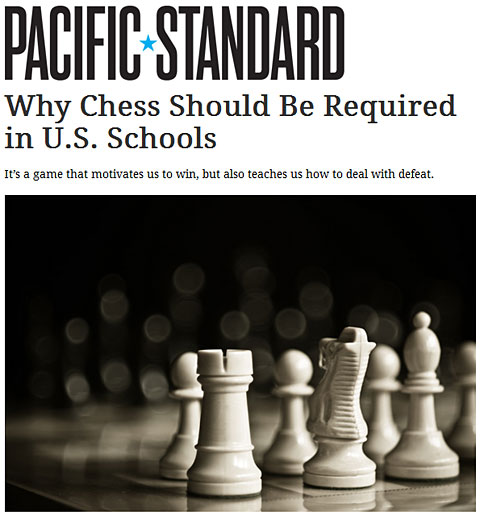
Desculpem ir em inglês mas este é o titulo de um artigo que vem no jornal online "Pacific Standard", que descreve, com a ajuda de um vídeo, como é que uma nação com 3 milhões de habitantes como a Arménia, está a usar o Xadrez para ensinar às crianças, coisas básicas da vida. A mesma tendência como ser observada por todo o Mundo, como na Grã-Bretalha, onde milhares de alunos jovens de escolas primárias estão a receber aulas de Xadrez ! Num programa do Governo Britânico de £700,000 !!!
É isto que tem de ser fomentado e incentivado. Já se começa a ver, como referi, uma tendência neste sentido mas... falta fazer muito. Não é só o bem que isto faz agora ou daqui a um mês ou a 1 ano - que já é muito bom, visível e fantástico - mas é o bem que isto vai fazer daqui a uma geração, mudando para uma mentalidade mais saudável e pacifica.
Worldwide, chess is still a popular game, but it is treated with particular
seriousness in Eastern Europe. In September 2011, Armenia made chess a required
subject for all children over the age of six. (In the DW-TV news clip below,
the children are in 2nd grade.)
Indeed, the Armenians may be on to something. One recent psychology study
found that chess was associated with greater “cognitive abilities,
coping and problem-solving capacity, and even socioaffective development
of children.” Of course, because it was a cohort (observational) study,
the link could be due to some third factor or the possibility that smart,
mature children are more inclined to play chess in the first place.
In the above video, the math/chess teacher says, “Chess trains logical
thinking. It teaches how to make decisions, trains memory, strengthens will
power, motivates children to win, and teaches them how to deal with defeat.
It’s the only school subject that can do all of this.”
That is a very interesting insight. Not only does chess help train the
brain, but it also teaches children basic life skills. In our culture, we
hand out trophies to winners and losers – or neglect to keep score
at all – out of some misguided, politically-correct notion that we
should never hurt anyone’s feelings. But, in Armenia, schools are
teaching children reality: Sometimes you lose. That’s an important
lesson, and it should be taught at a young age.
That is a very interesting insight. Not only does chess help train the
brain, but it also teaches children basic life skills. In our culture, we
hand out trophies to winners and losers – or neglect to keep score
at all – out of some misguided, politically-correct notion that we
should never hurt anyone’s feelings. But, in Armenia, schools are
teaching children reality: sometimes you lose. That’s an important
lesson, and it should be taught at a young age.
Americans are concerned that our children aren’t receiving a solid
K-12 education. Perhaps chess should be introduced into the curriculum as
a fun way to teach logic and memory?
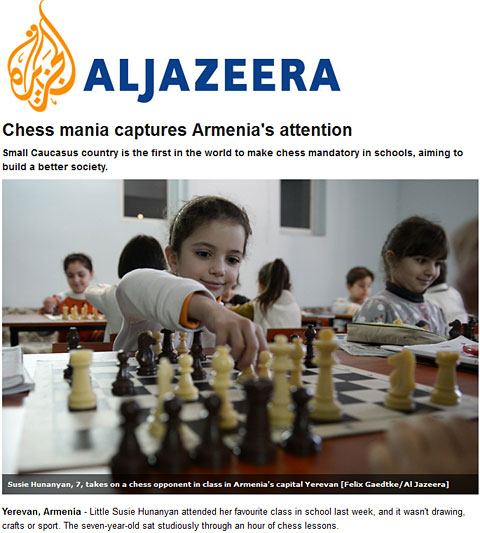
In Armenia, learning to play the grand game of strategy in school is mandatory
for children – the only country in the world that makes chess compulsory
– and the initiative has paid dividends. Armenia, a Caucasus country
with a population of just three million, is a chess powerhouse.
In 2011, Armenia made chess compulsory for second, third and fourth-graders.
That's why Susie and her classmates have two hours of chess every week in
school. For an hour, the students playfully engaged in one-on-one matches
against each other. "Chess is having a good influence on their performance
in other subjects too. The kids are learning how to think, it's making them
more confident," said teacher Rosanna Putanyan, watching her pupils
play from the periphery.
The chess initiative is not only meant to scout young talent but also build
a better society. Armen Ashotyan, Armenia's education minister, told Al
Jazeera the project is aimed at fostering creative thinking. "Chess
develops various skills – leadership capacities, decision-making,
strategic planning, logical thinking and responsibility," Ashotyan
said. "We are building these traits in our youngsters. The future of
the world depends on such creative leaders who have the capacity to make
the right decisions, as well as the character to take responsibility for
wrong decisions."
More than $3m has been spent on the project so far to supply chess equipment
and learning aids in all Armenian schools, Ashotyan added. The majority
of the budget was allocated to train chess players to become good teachers.
In coming years, spending on chess is expected to rise, he said.
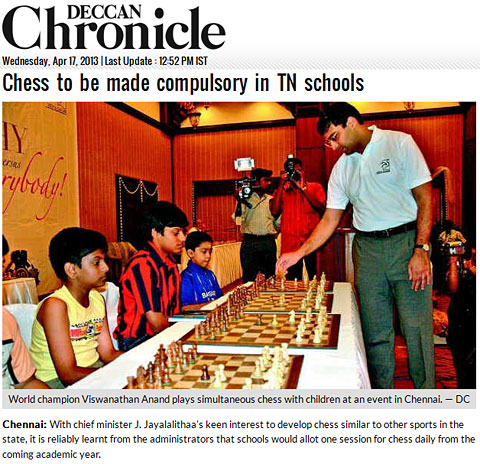
“A few schools like government higher secondary school in Sholinganallur
have already introduced the game among students. We expect the game to be
made mandatory from the ensuing academic year as CM wants to develop this
game,” said Dr N. Vijayan, principal and correspondent of Zion group
of schools and president of Kancheepurm District Chess Association.
The government has also decided to assess student’s skills in the
royal game and award marks for their achievements which would add up to
the final marks as part of continuous and comprehensive evaluation (CCE).
“The CCE marks will also be considered for promotion,” he added.
With chess being made compulsory in Tamil Nadu schools, soon we can expect
children to use the terms like Ruy Lopez, Sicilian Defence and stalemate
liberally as they use the cricketing terms like LBW, square cut and bouncer
today, aver chess enthusiasts.
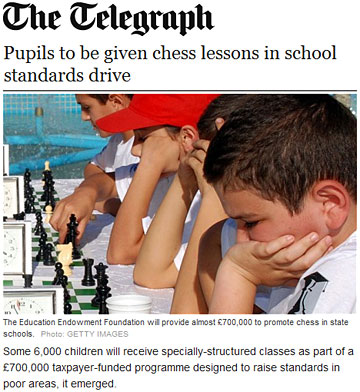
The scheme will target 10-year-olds in 100 schools to test the impact that
chess has on pupils’ abilities across a range of academic disciplines.
Experts believe that the game – which is already part of the curriculum
in some other countries – can dramatically improve pupils’ levels
of concentration, boost problem-solving skills and develop their thought
processes. It is also claimed that chess can boost numeracy levels with
knock-on benefits across other subjects. But figures suggest that fewer
than one-in-10 pupils in state schools currently get access to chess at
school, placing them at a disadvantage compared with privately-educated
peers.
Today, the Education Endowment Foundation – a Government-funded charity
established to help boost standards among poor pupils – announced
the award of a £689,000 grant to help spread the game in state primary
schools. The funding will be handed to the charity Chess in Schools and
Communities to stage special lessons in primaries across Liverpool, Bristol
and Manchester.
For more information on the initiative check out the following foundations
that are driving the initiative:

The majority of studies that link chess to academic attainment have been
carried out abroad and included self-selecting intervention groups. However
a randomised controlled trial was carried out in Italy and this showed that
chess had an impact on maths attainment. The EEF will be testing the programme
as a randomised controlled trial, with 50 schools receiving the intervention
in one year and 50 acting as a control group. Those in the control group
will receive the intervention in the following academic year. Pupils’
mathematical abilities will be tested before and after the intervention.
A ver também: